Sea Shepherd

Tuesday, July 6, 2010

Happy Birthday Dalai Lama


Tibetans around the world are celebrating the 75th birthday of the Dalai Lama, the exiled spiritual leader of Tibet.

The Dalai Lama addressed a crowd of well-wishers in Dharamshala, his adopted hometown in India, where he has lived in exile since 1959.  The Buddhist monk said when looking at the pictures and posters depicting his life, he realizes his life has not been wasted. 

In neighboring Nepal, exiled Tibetans celebrated the Dalai Lama's birthday in a camp on the outskirts of the capital, Kathmandu.

News reports say police detained for questioning about 20 Tibetans in Nepal.  Officials said they would not permit anti-China demonstrations, although birthday celebrations would be allowed. 

In Beijing, Chinese Foreign Ministry spokesman Qin Gang refused to comment on the Dalai Lama's birthday celebrations.  

Qin told reporters at a regular daily briefing that only two dates in Tibet's history are important:  March 28, 1951, when, as he said, "Tibet was Liberated peacefully;" and May 23, 1959, when, in his words, Tibet adopted democratic reform.

The Dalai Lama fled Tibet in 1959 after a failed uprising against Chinese rule.  China accuses him of inciting a separatist movement in Tibet.  He says he is not seeking independence for Tibet, just greater autonomy.  

Monday, July 5, 2010

BP Insider Admits Disaster Call Center Is A Diversion, Don't Even Take N...

Will BP Stop Burning Sea Turtles to Avoid a Lawsuit?

We’ve all been horrified by the reports of endangered sea turtles being incinerated alive in controlled burns set off by BP in the Gulf of Mexico. Now, animal conservation groups are doing something about it. Earlier this week, they filed a lawsuit against British Petroleum and the U.S. Coast Guard.
On Tuesday, the Animal Welfare Institute, the Center for Biological Diversity and Turtle Island Restoration Network notified BP and the Coast Guard of their intent to sue. The notice states that BP’s actions are resulting in the deaths of threatened and endangered species, in particular the Kemp's ridley sea turtle.
"While cleaning up the catastrophic oil spill is critically important, so too is doing it in a way which doesn’t destroy wildlife in a flagrantly unlawful manner," AWI President Cathy Liss said in a statement.
They asked BP and the Coast Guard to put qualified observers in the Gulf who can watch for and save endangered turtles and other wildlife. If turtles continue to die, the groups said they would file a lawsuit charging BP with violating the federal Endangered Species Act as well as the terms of its lease for Deepwater Horizon — a lease that requires BP to comply with all federal environmental laws.
Guess what? BP is apparently listening. In meetings held yesterday in New Orleans, representatives from BP, the Coast Guard, the three animal protection groups and the Animal Legal Defense Fund agreed that the Coast Guard will immediately gather a group of scientists and, with input from the animal groups, try to figure out how to best ensure that no endangered sea turtles are killed during burn containment practices.
Due to stormy weather in the Gulf, the burning will be halted until at least next Tuesday. By then, BP and the Coast Guard are supposed to let ALDF and the animal groups know if it will be possible to have scientists aboard every burn boat. If they say "no can do," the parties will go back to federal court.
Meanwhile, along with the Endangered Species Act violations, PETA rightfully believes BP should be charged with cruelty to animals. This week it called on the attorneys general of Alabama, Florida, Louisiana and Mississippi to file animal cruelty charges against the BP executives who allowed the deaths and injuries to happen and, due to their negligence, let it continue.
Robert Wine, a flack for BP, doesn’t understand all the hubbub. He told the Times-Picayune that the company always looks out for turtles and other wildlife before starting the burns. "The idea of animals being burned alive is appalling to us," he said.
Is it really? Then why has his company been turning away rescuers trying to save the poor creatures before the oil is set afire? What’s truly appalling to BP must be the fact that, if the lawsuit is successful, the company could be facing hefty fines for every single endangered sea turtle it has harmed or killed — up to $25,000 in civil penalties and up to $50,000 in criminal penalties, along with possible prison time. Are they really always looking out for turtles, as their P.R. guy claims ... or always looking out for themselves?
We should know the answer next Tuesday.

Veganism based on Jainism

Jainism

The vegan philosophy is essentially practical - centred on being a thinking, compassionate & discriminating consumer.  Of course it is far more than that, but from a practical day-to-day point of view 'ethical consumption' is prominent.  The vegan movement as we know it is a fairly recent phenomenon.  Thirty years ago it comprised a mere handful of far-sighted pioneers, while today there are likely to be some millions of adherents in the western world.  However, the fundamental vegan ethic is actually quite ancient :  under the name 'ahimsa'  (non-violence) it is a cornerstone of the Jain religion which was founded in India thousands of years ago.  Actually, ahimsa is a much broader concept that veganism as it can be defined as non-violence in thoughts, words & deeds, in all aspects of life.
Jainism as it exists today has developed from the teachings of Lord Mahavira, a historically verified person who lived in India at the same time as Lord Buddha - around 500 BC.  Mahavira is said to be the 24th jain sage, the earlier ones reaching back to perhaps 8,000 years ago.  Over this immense period of time the jains have developed a wonderfully intricate & complete system of compassionate living.  However, jainism is little known in the west because it does not have a proselytizing tradition, and also because jain monks are wandering ascetics who do not use any form of mechanical transport - ie their only means of transport between jain communities is walking.   The principal of non-violence is perhaps best know in the west through the life of Mahatma Gandhi. 
As with hinduism & buddhism, jains believe in re-incarnation : the cycle of birth, death & re-birth, the purpose of which is the gradual perfection of the soul to the point where it can be released from the cycle to a higher state of immersion with the infinite.  In contrast to the major popular religions the path to this release is by deeds rather than belief.  Deeds attract karmic matter which attaches to the soul - good karmic matter derives from right conduct; bad karmic matter from bad / incorrect conduct.   If one lives a life of dishonesty, disrespect, anger, violence, etc., no amount of repentance at the end of that life will erase the accumulation of bad karmic matter.  For the accumulation to be removed requires further life times devoted to peaceful, ethical behaviour.
Whether you are an atheist, agnostic, or a follower of another spiritual path, you're likely to find the jain philosophy of interest if you hold vegan / vegetarian inclinations.  It's worth knowing that many of the principles that define how you might think about your life & the world, & which you have probably come to by listening to your own heart have been contemplated & codified by an dedicated community of strict vegetarians since virtually the beginnings of human civilization.
Here are some really good sources of information on jainism:
*  www.cs.colostate.edu/~malaiya/jainlinks.html : an excellent gateway to jain web sites
*  'Jain Spirit' magazine, published in Uk : www.jainspirit.com
*  "Life Force - the world of Jainism" by Michael Tobias:  a very readable discussion of jainism from a western ecological perspective.  This book is available from Vegan Wares.  Email us for further details.

Saturday, June 12, 2010

Knights of Consequences ~ Defending and Honoring Captain Pete Bethune and the principles of SSCS

Knights of Consequences


Defending and Honoring Captain Pete Bethune and the Principles of the Sea Shepherd Conservation Society


Commentary by Captain Paul Watson

The complications that accompany Sea Shepherd campaigns are immense. Seldom are things simple, and the reason for this is the complexity of running an international marine conservation organization that is dependent upon the passion, dedication, and unfortunately the unpredictability of volunteers.

I have always stressed that the kind of passion that volunteers bring to the table is something that cannot be hired. Professionals simply do not compare. As Sir Ernest Shackleton once remarked when he was criticized for the inexperience and the lack of professionalism of his crew, “I need men of passion who will get me to the Pole and that kind of passion cannot be bought, it can only be found in the dedication of volunteers.”

Since 1977, I have commanded the helm of the Sea Shepherd Conservation Society and during that time, it has been my honor and my worry to have experienced the passion of over 4500 volunteers. A few have been found wanting, but most of them were exceptional and a few were extraordinary.
Balanced within the fragile framework of organized passion, I have to make practical logistical decisions designed not only to achieve the success of our campaigns but also designed to defend the integrity and the survival of the Sea Shepherd as an organization.

And it has been this strategy of balance that has achieved the remarkable record that Sea Shepherd enjoys: no injuries caused, no serious injuries sustained, no civil lawsuits, and no legal convictions for indictable (felony) offenses.  
The implementation of this strategy has sometimes resulted in criticism from the public, the media, and occasionally our own crew and supporters. And this criticism is independent of the criticism we routinely get from some of the public and the media for the strategies and tactics of our campaigns.

Recently Sea Shepherd was forced to make a decision that was understandably unpopular with some of our supporters. We had to announce that Captain Pete Bethune will not be able to rejoin the Sea Shepherd crew when we return to the Southern Ocean in December 2010 to defend the whales.

This was not a decision taken lightly, it was a decision taken out of necessity both for Captain Bethune and for the Sea Shepherd Conservation Society.

Captain Bethune is a genuine hero, not just to Sea Shepherd, but to people around the world who love whales and want to see the brutal and remorseless slaughter of these whales ended. He has made sacrifices and he repeatedly risked his life to defend the whales. Captain Bethune is not unique amongst my crew in this regard, but with reference to Operation Waltzing Matilda he was exceptional.

But he violated a basic tenet of the rules of engagement of the Sea Shepherd Conservation Society and thus we had no alternative but to make the decision to not have Captain Bethune participate in future campaigns.

Captain Bethune had already told the Japanese court that he would not be returning and our decision further convinced the Japanese judges that they had nothing to fear from letting Pete return home. The judges are concerned that Japan would lose face if they released him only to board another whaling ship in the Southern Ocean once again. Captain Bethune saying that he would not return was not sufficient to convince the judges, but his statement backed up by Sea Shepherd’s decision to not have him participate will considerably help to alleviate the concerns of the judges.

As to the nature of the violations against Sea Shepherd policy, it is not in our interest or Captain Bethune’s to go into any detail. It is simply sufficient for us to say that we were compelled to make this decision for very good reasons both in the interest of Captain Bethune and of Sea Shepherd.

Accusations that Sea Shepherd has abandoned Captain Pete Bethune are untrue. Captain Bethune’s legal expenses, which Sea Shepherd is helping to cover, have accumulated quickly to hundreds of thousands of dollars. We have helped to secure the best legal team available for him in Japan. We will continue to provide a legal defense for Captain Bethune.

Accusations that Sea Shepherd, and I specifically, ordered Captain Bethune to board the Shonan Maru 2 in the Southern Ocean are untrue. Captain Bethune at one point in his interrogation told the Japanese Coast Guard that he acted under my orders. This accusation resulted in the Japanese Coast Guard issuing a warrant for my arrest. Captain Bethune sent me a letter a few weeks afterwards apologizing for this and saying he would retract the statement, and he did so.

Unfortunately the Japanese Coast Guard did not retract the warrant. I believe considering the intense interrogation methods by the Japanese interrogators that it is understandable why Captain Bethune gave them information that they wanted and told them things they wanted to hear. I hold no grudge against him for that.
Captain Bethune has been under enormous pressure during his incarceration with long hours, and day after day of interrogation. We know how intense it can be because in November 2003, Captain Alex Cornelissen and crewmember Allison Lance were held without bail, without a lawyer and interrogated for several weeks before being released.

He has also been abandoned by his own government, a government that cowardly refused to defend the New Zealand flag of his vessel Ady Gil and refused to defend his rights as a New Zealand citizen. The captain of the Shonan Maru 2, deliberately rammed and destroyed the Ady Gil. This was a vessel Bethune built himself and set a world record for circumnavigating the globe. And yet the New Zealand government refused to question the Japanese captain over the ramming, basically giving a green light to further Japanese violence against Sea Shepherd next season.

I think however the light is on the horizon for Captain Bethune’s release. The Japanese court will most likely find him guilty.(After all, they have a 98% conviction rate, which is enough to make one wonder why they even bother having lawyers, and damn expensive ones at that!)

Sea Shepherd is focused on getting Bethune out of a Japanese prison where he is being treated as a prisoner of war and seeing him returned to his home in New Zealand to be re-united with his family and friends. We believed we have done all that is possible towards achieving that objective.

We believe that we have made the right decisions to protect both Captain Bethune and the Sea Shepherd Conservation Society. We realize that not everyone will be in agreement with the decisions we make, but then again everyone who is in disagreement does not have to deal with the consequences. The consequences are ours, and sometimes no matter what the decision, negative consequences can result.
At this moment, Sea Shepherd is focused on freeing Captain Bethune, interfering against bluefin tuna poachers in the Mediterranean, opposing the slaughter of dolphins in Taiji, Japan, helping to protect the Galapagos, addressing the Gulf of Mexico oil spill disaster, protecting sharks in Latin America, and beginning the incredibly difficult and intense effort to organize Operation No Compromise - our return to the Southern Ocean to defend the whales of the Antarctic Southern Ocean Whale Sanctuary for the 7th time.

Captain Bethune’s actions saved the lives of many whales and the actions of all the Sea Shepherd crew this last season saved the lives of 528 whales. It was an enormously successful campaign and these whales continue to swim free and alive in the Southern Ocean as a result of our efforts.

Eighty men and women from eighteen different nations spent nearly four months at sea on three different vessels under the command of three different captains and they all took exceptional risks and gave unselfishly of their time. We lost one vessel, the Ady Gil, we suffered damage to our ship the Bob Barker, and Captain Bethune was taken prisoner by the ruthless whaler who destroyed his ship and almost killed his shipmates, a whaler who has escaped prosecution for his crime while his victim is persecuted in Japan for daring to confront his attacker.

We expect the conflict to escalate in the 2010/2011 season and we must expect that more Sea Shepherd crew may be taken prisoner or injured. But when we say we are willing to risk our lives and our freedom to defend the whales, we must be prepared to walk the walk.

Captain Bethune, like many Sea Shepherd crew members before him, was taken prisoner. It was not the first time this has happened at Sea Shepherd, nor will it be the last. This is a dangerous game we play with those who ruthlessly plunder of oceans of life.

Bethune told me that he was prepared for the consequences when he made the decision to board the Japanese whaler and I believe that he has handled himself admirably and has been steadfast in his convictions to defend the whales in the Southern Ocean Whale Sanctuary from the poachers from Japan. He is a whale warrior extraordinaire and a hero, and he has earned a place in conservation history for his efforts, his courage, and his sacrifice.

Saturday, May 29, 2010

Haunting Images from the Oil Spill

*heavy sighs* :o(

Shrimp boats equipped with booms collect oil in Chandeleur Sound, La., on May 5. (AP Photo/Eric Gay)

Oil moves past an oil rig, top right, in Chandeleur Sound on May 5. (AP Photo/Eric Gay)


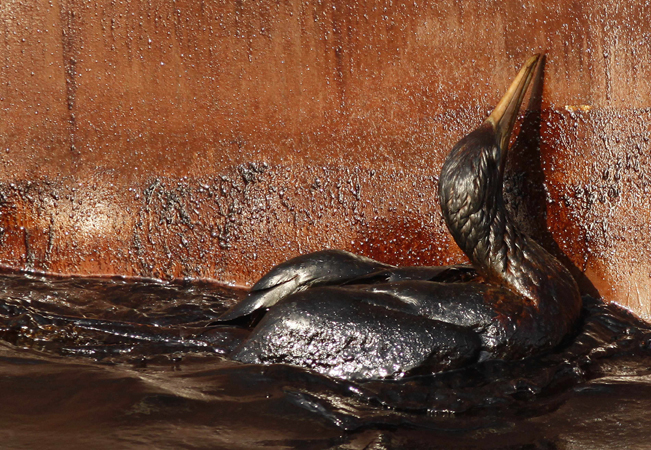
An oil-soaked bird struggles against the side of an Iron Horse supply vessel at the site of the oil spill off Louisiana on May 9. (AP Photo/Gerald Herbert)

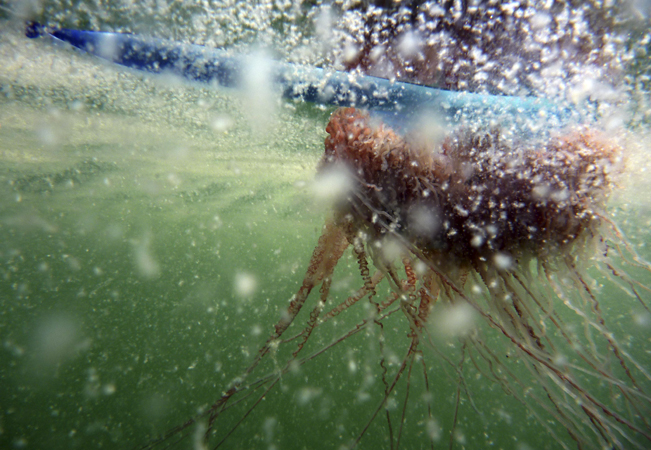
A Portuguese man-of-war is seen from under the oily water in Chandeleur Sound on May 6. (AP Photo/Alex Brandon)

A dead jellyfish floats amid oil May 6 in the Gulf of Mexico, southwest of the Southwest Pass of the Mississippi River on the coast of Louisiana. (AP Photo/Patrick Semansky)

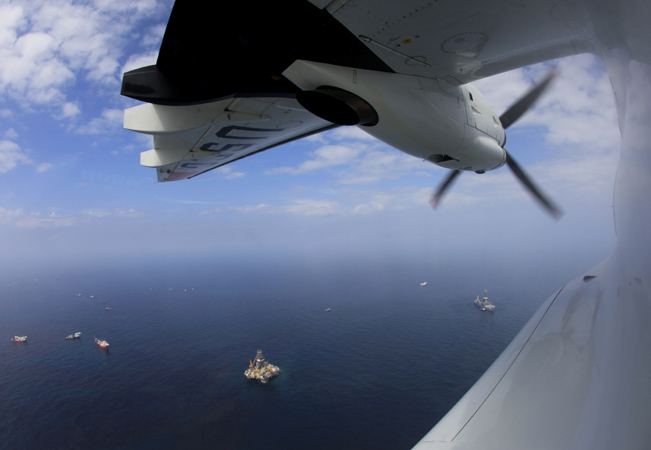
A Coast Guard plane flies over the Development Driller III oil drilling platform, which was drilling a relief well May 12 at the site of the Deepwater Horizon oil spill. (AP Photo/Charlie Riedel)

Risers, the outer casings of oil drill pipes, are seen on the deck of the service vessel Joe Griffin as it prepares to head to Port Fourchon, La., on May 11. (Pool Photo/Gerald Herbert)

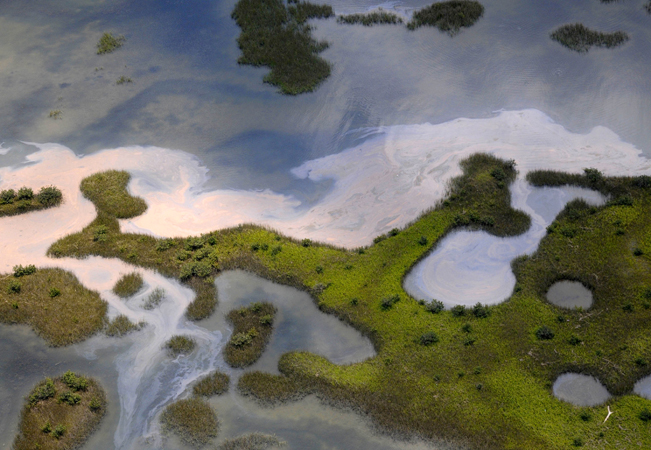
An aerial view of the northern Chandeleur barrier islands, 20 miles from the main Louisiana coastline, shows sheens of oil reaching land May 6. (AP Photo/David Quinn)

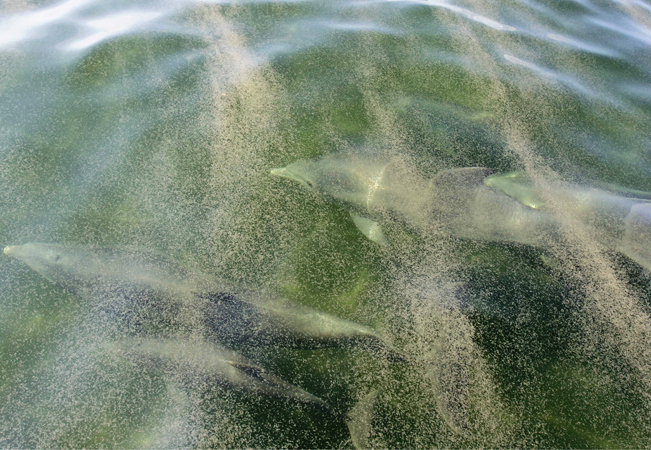
A pod of bottlenose dolphins swims in the oily water of Chandeleur Sound on May 6. Five days later, six dead dolphins were found along the Gulf Coast. Officials were investigating oil's role in the deaths. (AP Photo/Alex Brandon)

An oil-stained cattle egret is seen on the deck of the Joe Griffin supply vessel May 9. (AP Photo/Gerald Herbert)

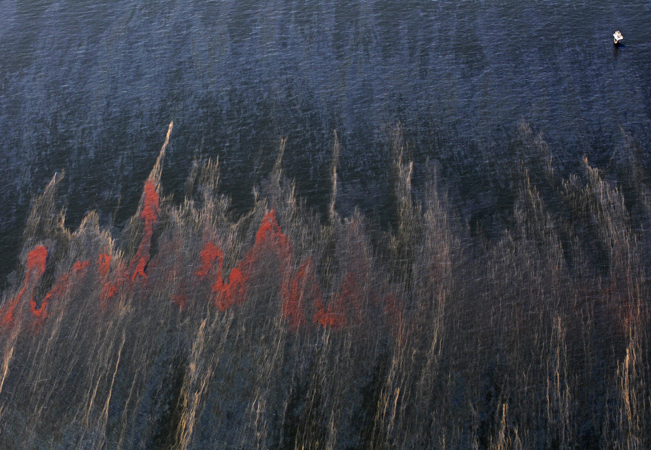
Oil swirls in the Gulf of Mexico currents May 6. (AP Photo/Dave Martin)

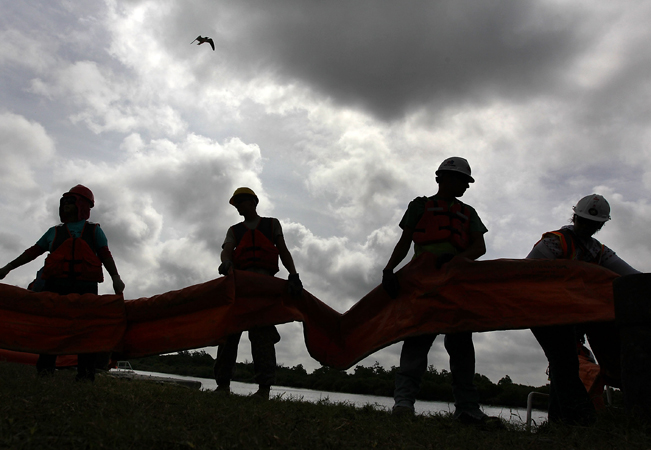
Contractors unload oil booms to protect marshlands May 13 in Hopedale, La. (John Moore/Getty Images)

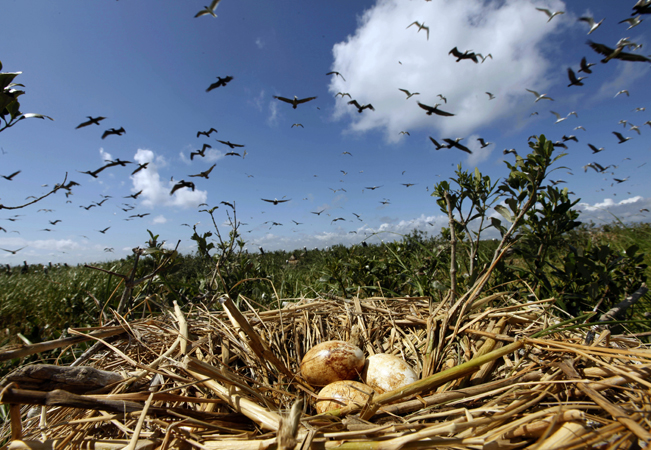
Pelicans fly past a nest of eggs apparently stained with oil on a Louisiana island May 22. The island is home to hundreds of brown pelican nests as well as terns, gulls and roseated spoonbills. (AP Photo/Gerald Herbert)

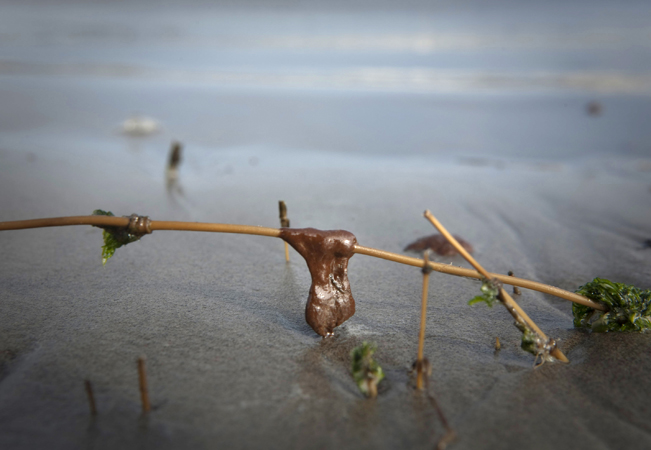
A glob of oil thought to be from the massive oil spill in the Gulf of Mexico sits on a reed on a beach in Southwest Pass, La., on May 15. (Reuters/Lee Celano)

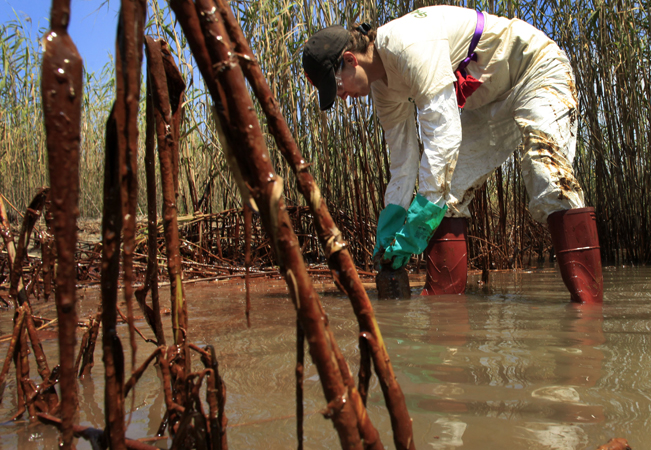
A Greenpeace worker collects samples of oil May 19 that washed up along the mouth of the Mississippi River near Venice, La. (AP Photo/Charlie Riedel)

An oil-covered dragonfly, stuck to marsh grass, tries to clean itself May 18 in Garden Island Bay near Venice. (AP Photo/Gerald Herbert)

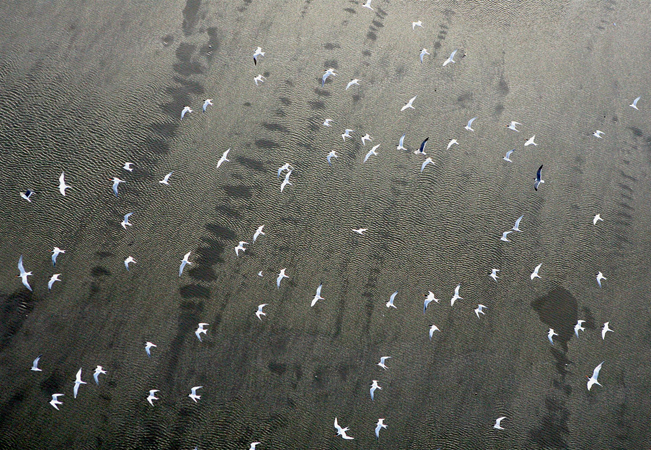
Birds fly over oil on the water April 29 near Breton Sound Island, on the southernmost tip of the Chandeleur Islands. (Reuters/Sean Gardner/?Greenpeace/?Handout)?